> For the complete documentation index, see [llms.txt](https://wiki.swot.de/handbuch/llms.txt). Markdown versions of documentation pages are available by appending `.md` to page URLs; this page is available as [Markdown](https://wiki.swot.de/handbuch/webreporting/dashboard-im-swot-controlling.md). Agents can also search and read this documentation through its [MCP server](https://wiki.swot.de/handbuch/~gitbook/mcp).
# Dashboard im SWOT Controlling
Es ist also vollbracht, wir haben die Berichte auf dem Reporting Server eingerichtet und es werden nun auch die Daten angezeigt. Theoretisch könnte es hier enden, der Anwender kann sich nun seine Auswertung leicht z.B. mittels Webbrowser anzeigen lassen.
Es wurde aber auch die Möglichkeit geschaffen, die Berichte in die SWOT Controlling Oberfläche einzubinden.
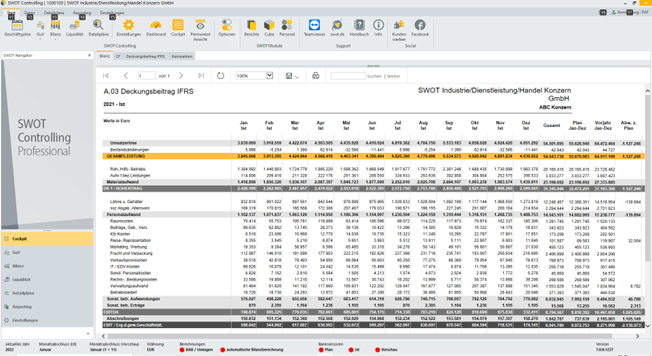
Zur Dashboard Ansicht gelangt man über den Button *Dashboard* im Cockpit von SWOT Controlling.
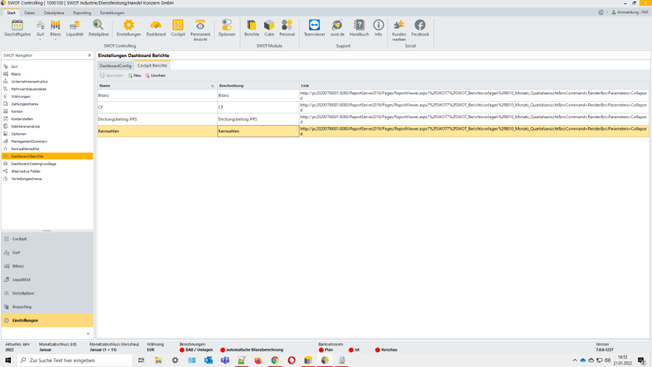
Die verschiedenen hinterlegten Berichte kann man über die Tabs im Kopfbereich der Seite erreichen. Das Einbinden der Berichte erfolgt über den Punkt *Dashboard Berichte / Cockpit Berichte* in den *Einstellungen*.
Der *Name* gibt dabei die Bezeichnung des Tabs im *Dashboard* an. Die Bemerkung ist zurzeit noch ohne Funktion.
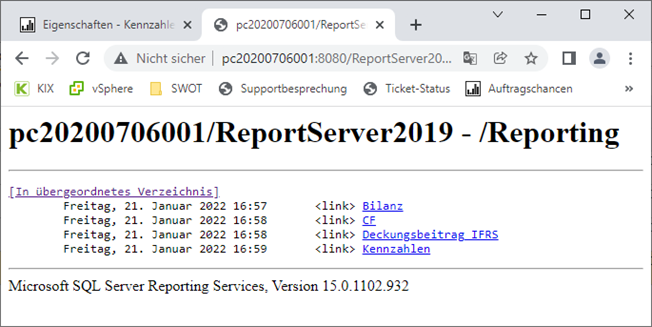
Der *Link* ist der Link zum anzuzeigenden Bericht. Diesen Link erhält man, in dem man mit einem Webbrowser über den Web-Dienst-Link bis zu dem gewünschten Bericht navigiert.
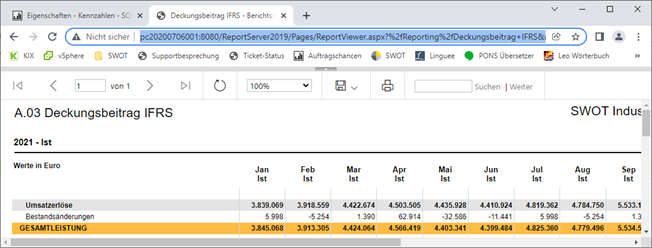
Und dort dann den Link aus der Adressleiste des Webbrowsers kopiert.
Es empfiehlt sich hier vor allem verknüpfte Berichte zu benutzen, da so vom Anwender beim Aufruf keine Eingaben erforderlich sind.
Die Links lassen sich noch durch diverse zusätzliche Parameter erweitern.
Hier einige kleine Beispiele. Diese einfach hinten an den jeweiligen Berichts-Link anfügen.
| Parameter | Beschreibung |
| ------------------------- | --------------------------------------------------- |
| \&rc:Parameters=Collapsed | Die Leiste mit den Parametern ist zusammengeklappt. |
| \&rc:Parameters=False | Es gibt keine Parameterleiste. |
| \&rc:Toolbar=false | Es gibt keine Toolbar (Export, Drucken, Suchen, …). |
| \&rc:Zoom=80 | Der Bericht wird auf 80% gezoomt. |
| \&rc:Zoom=Page Width | Der Bericht wird auf „Seitenbreite“ gezoomt. |
Mehr Infos gibt es unter folgenden Links:
1. \\
2.
---
# Agent Instructions
This documentation is published with GitBook. GitBook is the documentation platform designed so that both humans and AI agents can read, navigate, and reason over technical content effectively. Learn more at gitbook.com.
## Querying This Documentation
If you need additional information that is not directly available in this page, you can query the documentation by asking a question.
Perform an HTTP GET request on the following URL with the `ask` and `goal` query parameters:
```
GET https://wiki.swot.de/handbuch/webreporting/dashboard-im-swot-controlling.md?ask=&goal=
```
`ask` is the immediate question: it should be specific, self-contained, and written in natural language.
`goal` is what the user is ultimately trying to achieve, the reason they need the answer. Sharing it helps GitBook give you a better, more relevant answer. A goal is most helpful when it describes the outcome the user wants rather than restating the question. For example, with `ask=how do I create an API token`, a goal like `automate deployments from our CI pipeline` lets GitBook tailor the answer to that use case.
The response will contain a direct answer to the question and relevant excerpts and sources from the documentation.
Use this mechanism when the answer is not explicitly present in the current page, you need clarification or additional context, or you want to retrieve related documentation sections.